
The Best Choices for Your Project
Provide you with cement drying solutions
- Production capacity: 1-20T/H.
- Various types of coconut shell dryers can be customized
- Dryer length: 8 meters to 60 meters.
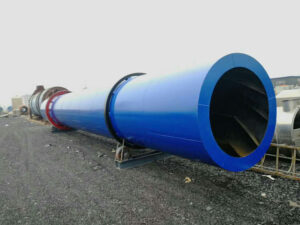
Cement Dryer
A cement dryer is a large-scale drying equipment and an essential part of the cement production line. It is used to dry both cement raw materials and finished cement, reducing moisture content to below 1%.
Cement dryers primarily work by efficient heat exchange between hot air and materials, quickly removing excess moisture so that the moisture content meets the ideal standards for subsequent grinding or storage.
Also known as a rotary kiln cement dryer, the cement dryer adopts a rotary drum design and utilizes the principle of hot air exchange to achieve drying.
During operation, cement enters the dryer through the feeding system. Inside the drum, hot air continuously flows in and comes into contact with the wet cement. Wet cement tends to clump together, so the dryer is equipped with lifting plates that stir and break up the material, increasing contact with hot air. After drying, cement is automatically discharged through the outlet system.
The drying process is equipped with a high-efficiency dust collection system, continuously capturing moisture and dust to achieve pollution-free drying throughout the process.
| Model | Daily Output (t/d) | Drying Capacity (t/h) | Raw Material Moisture | Dried Material Moisture | Drying Temperature (°C) | Total Power (kw) | Total Weight (kg) | Occupied Area (㎡) |
|---|
| JHD-1210 | 44.0-19.5 | 0.565 | 35-50% | 4-15% | 370±100 | 28 | 13,500 | 5*15 |
| JHD-1409 | 46.5-20.5 | 0.595 | 34% | – | – | 15,500 | 5*15 |
| JHD-1615 | 88.0-39.0 | 1.130 | 45% | – | – | 19,500 | 6*22 |
| JHD-2010 | 144.5-63.5 | 1.850 | 78% | – | – | 25,000 | 8*18 |
| JHD-2210 | 154.0-67.5 | 1.976 | 85% | – | – | 27,000 | 10*18 |
| JHD-2510 | 193.0-83.5 | 2.427 | 110% | – | – | 35,000 | 10*18 |
| JHD-2512 | 227.0-100.0 | 2.912 | 125% | – | – | 38,000 | 10*20 |
| JHD-2912 | 268.0-120 | 3.432 | 135% | – | – | 43,500 | 10*22 |
Advantages of a Cement Dryer
Large-Scale Drying
Cement plants typically have high production volumes. Our cement dryer can operate continuously for 24 hours. The dryer diameter can reach up to 3.5 meters, with lengths over 50 meters, suitable for large-scale production.
Stable Operation
The cement dryer uses wear-resistant and high-temperature-resistant materials, ensuring low failure rates and long-term continuous operation.
High Automation
The cement dryer can achieve automated operation during the drying process, improving production efficiency.
Excellent Drying Performance
The unique hot air drying technology and internal lifting plate design ensure even heating of the material, with stable and extremely low moisture content after drying.
Key Points When Drying Cement
Control Initial Moisture
Fluctuating moisture content in raw cement can affect overall drying efficiency.
Temperature Control
Too high → surface hardening (caking), making internal moisture difficult to remove and potentially reducing cement reactivity.
Too low → incomplete drying.
Hot air inlet temperature is generally controlled between 700°C – 900°C, and outlet temperature is typically maintained between 90°C – 120°C.
Efficient Environmental System
Cement drying produces a large amount of dust. A high-efficiency dust collection system is required. We use a multi-bag dust collector to ensure effective dust removal.
Why Use a Rotary Cement Dryer?
Suitable for large-scale drying.
Improves grinding efficiency – dried cement can be fed into ball mills for further processing, reducing grinding energy consumption.
Capable of drying various raw materials, such as slag and fly ash.
Supports continuous production, ensuring stable cement output.