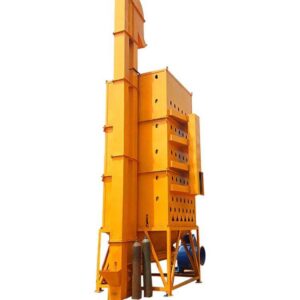
A grain dryer is mainly used for drying grains such as barley, wheat, corn, paddy rice, peanuts, and more. The grain dryer adopts a tower-type design, consisting primarily of a hot air furnace and the main drying body. Grains are fed into the dryer from the bottom and dried using hot-air heat exchange. During the drying process, the generated steam is discharged in real time through reserved moisture outlets. We can provide customized solutions for drying 10–500 tons of grain per day.
As grain dryer designers, we adopt the principle of low-temperature mixed-flow drying.
Heating – The grain dryer heats air through the hot air furnace. Different heating methods are available, such as coal, wood pellets, electricity, or natural gas.
Drying – Grains are lifted to the top of the dryer and then flow downward slowly by gravity. Hot air, blown in by a fan, passes through layers of staggered angular boxes from all directions, penetrating the grain flow. The hot air exchanges heat with the grains, evaporating surface moisture. The drying process alternates between “drying and tempering” until the target moisture content is reached. Moisture and dust are collected simultaneously.
Discharge – After drying, the grains are automatically discharged. Typically, the final moisture content of dried grain is about 12%.
No. | Item | Unit | Design Value
1 | Model Name | / | 5HL-150 (Multi-functional) Dryer
2 | Structural Type | / | Multi-functional
3 | Drying Method | / | Direct Heating
4 | Drying Process | / | Counter-Parallel Flow
5 | Dryer Body Dimensions (L × W × H) | mm | 2640 × 4090 × 19000
6 | Processing Capacity | t/d | 150
7 | Moisture Reduction Range | % | 5–15
8 | Number of Drying Sections | pcs | 5
9 | Number of Tempering Sections | pcs | 4
10 | Total Height of Drying Sections | mm | 6900
11 | Total Height of Tempering Sections | mm | 2400
12 | Cooling Section Height | mm | 1800
13 | Hot Air Temperature Range | ℃ | 60–170
14 | Number of Hot Air Fans | pcs | 2
15 | Hot Air Fan Air Supply Type | / | Positive Pressure
16 | No.1 Hot Air Fan Model | / | Y6-45-10D Centrifugal Fan
17 | No.1 Hot Air Fan Motor Power | kW | 30
18 | No.2 Hot Air Fan Model | / | Y6-45-9.5D Centrifugal Fan
19 | No.2 Hot Air Fan Motor Power | kW | 22
20 | Number of Cooling Fans | pcs | 1
21 | Cooling Fan Model | / | 4-72-7C Centrifugal Ventilation Fan
22 | Cooling Fan Motor Power | kW | 7.5
23 | Heat Source Type | / | Fuel Oil / Gas / Biomass, etc.
24 | Heat Source Equipment Model | / | 5HJ-180
25 | Heat Source Thermal Power (Output Heat) | kJ/h (kcal/h) | 1,800,000 kcal/h
26 | Hoisting Equipment Motor Power | kW | 5.5 × 1 unit
27 | Grain Stirring Motor Power | kW | 0.75 × 1 unit
28 | Total Power | kW | 65.75