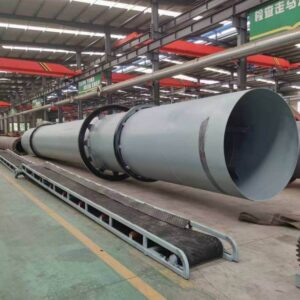
chemical dryer
The Best Choices for Your Project
We supply industrial rotary kiln drying equipment
- Customization Service:The maximum customizable diameter is 3.5 meters
- Solution:Provide solutions for your problems
- Dryer length: 8 meters to 50 meters.
chemical dryer
Chemical dryers are industrial equipment specialized for drying chemical raw materials. In chemical production, many chemical materials have strict humidity requirements before storage, transportation, or subsequent processing. Chemical dryers utilize a drum-type design and utilize principles such as heat and vacuum airflow to achieve rapid and uniform drying of materials, making them an indispensable and critical component of chemical production lines.
Unlike conventional dryers, chemical dryers can be constructed of stainless steel, offering corrosion resistance, sealing, and explosion-proof safety.
The basic operating principles of chemical dryers revolve around two processes: heat transfer and mass transfer.
Heat transfer: A heat source (hot air, coal, electricity, or natural gas) transfers heat to the wet material, causing the moisture (or solvent) on its surface to gain energy and vaporize.
Mass transfer: The vaporized water vapor diffuses from the material surface into the surrounding airflow, where it is carried directly to the dust collector.
- What are some common chemical dryer models?
Chemical dryers are primarily available in the following models, depending on material characteristics (such as viscosity, heat sensitivity, and particle form) and production requirements:
Specifications of Rotary Kiln Dryer
| Model (Diameter × Length, m) | Speed (r/min) | Slope (%) | Capacity (t/h) | Main Reducer Model | Ratio | Main Motor Model | Power (kW) | Speed (r/min) | No. of Supports | Weight (t) | Remarks |
|---|---|---|---|---|---|---|---|---|---|---|---|
| φ1.9/1.6×36 | 0.53–1.59 | 4 | 2.5–4 | JZQ750-1 | 45.58 | JZT-72-4 | 30 | 1200/400 | 3 | 53 | – |
| φ2.1/1.8×36 | 0.5–1.51 | 4 | 3.9–5 | UT2-110 | 163.36 | JZS-81 | 30 | 1410/470 | 3 | 75 | – |
| φ1.2×25 | 0.5–1.6 | 3 | 0.3–1.2 | PM650 | 40.17 | JZTY71-4 | 15 | 1200/120 | 3 | 34 | – |
| φ1.6×32 | 0.158–0.258 | 3 | 0.6–2 | PM750 | 48.57 | JZJY61-4 | 22 | 1200/120 | 3 | 46.82 | – |
| φ1.8×45 | 0.66–1.98 | 4 | 1–4.5 | UT2-110 | 163.36 | JZS-81 | 30 | 1410/470 | 3 | 80 | – |
| φ2.2×50 | 0.125–1.25 | 3.5 | 2–8 | ZS145-11 | 157 | YCT280-4A | 45 | 1320/132 | 3 | 130.71 | – |
| φ2.5×50 | 0.516–1.549 | 3.5 | 5.5–13 | ZS165-7 | 99.96 | YCT355-4A | 55 | 1320/440 | 3 | 167.5 | – |
| φ3×48 | 0.3309–3.309 | 3.5 | 9–20 | ZL130-14 | 32.11 | ZSN4-250-21B | 90 | 1500/150 | 3 | 237 | External decomposition |
| φ3.2×50 | 0.398–3.975 | 3.5 | 13–32 | ZL130-16 | 40.85 | ZSN4-280-11B | 190 | 1000/100 | 3 | 263 | External decomposition |
| φ3.3×52 | 0.391–3.91 | 3.5 | 14–38 | ZSY500-28 | 27.707 | ZSN4-315082 | 190 | 1000/100 | 3 | 280.8 | External decomposition |
| φ4×60 | 0.396–3.96 | 3.5 | 32–80 | ZSY630-35.5 | 34.601 | ZSN-355-092 | 315 | 1000/100 | 3 | 487.5 | External decomposition |
| φ4.2×60 | 0.4165–4.165 | 3.5 | 45–100 | ZSY710-35.5 | 35.526 | ZSN4-355-12 | 420 | 1000/100 | 3 | 576.1 | External decomposition |
| φ4.3×62 | 0.398–3.98 | 3.5 | 51–120 | ZSY710-35.5 | 35.714 | ZSN4-355-12 | 420 | 1000/100 | 3 | 598.5 | External decomposition |
| φ4.8×74 | 0.35–4 | 4 | 90–200 | JH710C-SW305-40 | 42.226 | ZSN-400-092 | – | – | – |
Working Principle
Applicable Materials
Disc Dryer: Materials move across multiple layers of slow-rotating heating discs, where they are indirectly heated and dried by the heat medium within the discs. Suitable for pastes, powders, and granular materials, such as dyes, pigments, and calcium carbonate.
Spray Dryer: Liquid materials are atomized into tiny droplets, which are then exposed to co-current or counter-current hot air, instantly drying them into a powder. Suitable for solutions, suspensions, and emulsions, such as ceramic slurries, pesticides, and dyes.
Fluidized Bed Dryer: Hot air flows upward through the material bed, suspending the particles in a fluidized state and achieving efficient heat and mass transfer. Suitable for granular and crystalline materials, such as fertilizers, plastic pellets, and salt.
Paddle Dryer: Indirect heating is achieved through a hollow shaft with paddles, providing uniform heat transfer during agitation. Suitable for highly viscous and wet materials, such as sludge, filter cakes, and viscous chemical products. Rotary drum dryers dry materials in a tilted, slowly rotating drum, directly or indirectly contacting the heated air within. They are suitable for large-volume, blocky, or flaky materials, such as slag, sand, and fertilizers.
Vacuum dryers lower the boiling point of water in a vacuum environment, achieving low-temperature drying and protecting heat-sensitive materials. They are suitable for heat-sensitive, easily oxidized, and toxic chemical products, such as pharmaceutical intermediates and high-end dyes.
We specialize in drum dryers and vacuum dryers for our customers.

We specialize in drum dryers and vacuum dryers for our customers.
Fourth, What Chemical Products Can Chemical Dryers Dry?
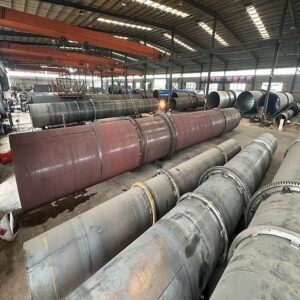
Chemical dryers have a wide range of applications, covering nearly all chemical sub-industries:
Inorganic chemicals: Soda ash, boric acid, sodium sulfate, catalysts, various metal hydroxides, etc.
Organic chemicals: Synthetic resins, plastic granules, organic pigments, dyes, pesticide technicals, etc.
Fertilizer industry: Urea, ammonium phosphate, compound fertilizers, potassium chloride, etc.
Fine chemicals: Pharmaceutical intermediates, food additives, pigments, coatings, detergents, etc. Environmental Protection Industry: Chemical sludge, metal waste, industrial by-product gypsum, etc.
- How to Choose a Heat Source for Drying Chemical Products?
The choice of heat source directly affects drying cost, efficiency, and product quality. A comparison of common heat sources and their energy efficiency is shown below:
Natural Gas/Coal Gas: Energy Efficiency: High calorific value, low cost, and rapid temperature rise. Direct combustion produces high-temperature hot air, resulting in low operating costs and suitable for locations with strict environmental requirements.
Electric Heating: Energy Efficiency: Precise temperature control, zero pollution, and simple equipment. High thermal efficiency, but with the highest operating costs. It is typically used for small equipment or applications requiring extremely high temperature control.
Coal/Biomass: Energy Efficiency: Low initial cost, but with significant environmental pressures. It is still used in some areas with less stringent environmental requirements or abundant resources, but is gradually being replaced by clean energy sources.
Customers can choose a heat source based on their specific needs, and we will tailor a heat source solution to suit their specific needs.
We Can Customize Your Chemical Dryer!
We understand that no single standard model can solve every problem. Your chemical products may have unique physical and chemical properties, your production site may have specific space constraints, and your process may have unique temperature control or cleanroom requirements.
This is where our specialized customized services come into play:
Material Adaptability: We tailor materials (such as stainless steel or special alloys), internal structures, and process flows to your specific materials (high viscosity, explosiveness, oxidation-proneness, heat sensitivity, etc.).
Capacity and Dimension Customization: We design the most appropriate equipment size based on your production needs, avoiding waste caused by over-stretching or insufficient production capacity.
Heat Source and Energy Efficiency Optimization: We design the most efficient heat utilization solution based on your energy needs, helping you reduce long-term operating costs.
Automation Control Customization: We integrate PLC or DCS control systems to achieve one-touch start and stop, precise parameter control, and remote monitoring, enhancing production intelligence.