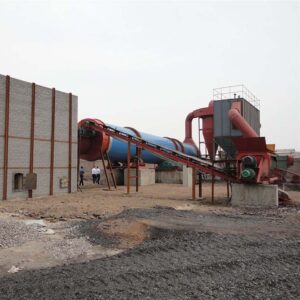
ore dryer machine
The Best Choices for Your Project
- Customization Service:The maximum customizable diameter is 3.5 meters
- Solution:Provide solutions for your problems
- Dryer length: 8 meters to 50 meters.
ore dryer machine
An Ore Dryer Machine, often a industrial rotary dryer, is essential equipment in the mineral processing industry. It is designed to efficiently remove moisture from various types of ores through the application of heat. This drying process is a critical step before further processing like smelting, transportation, or storage, as it reduces weight, improves efficiency, and prevents issues like caking or freezing during transit.
By reducing the moisture content, ore dryers ensure a more consistent and higher-quality feedstock for downstream operations, leading to significant cost savings and improved overall plant productivity.
Our robust ore drying machines are engineered to handle a wide range of mineral ores, including but not limited to:
Iron Ore: Essential for pelletizing and sintering processes.
Copper Ore & Concentrate: Prepares material for smelting.
Gold Ore: Dries tailings or pre-treated ore for further extraction.
Bauxite: Removes surface moisture before refining into alumina.
Zinc & Lead Concentrate: Critical step before furnace operations.
Nickel Ore: Ensures efficient processing in later stages.
Manganese Ore
Chrome Ore
And many other non-ferrous and ferrous ores.
| Model | Drum Diameter (m) | Drum Length (m) | Evaporation Capacity (kg H₂O/h) | Power (kW) | Suitable Ore Capacity* (TPH) |
|---|---|---|---|---|---|
| ORD-1215 | 1.2 | 15 | 500 – 1,000 | 18.5 – 22 | 3 – 6 |
| ORD-1520 | 1.5 | 20 | 1,000 – 1,800 | 30 – 37 | 6 – 12 |
| ORD-1824 | 1.8 | 24 | 1,800 – 3,000 | 45 – 55 | 12 – 20 |
| ORD-2228 | 2.2 | 28 | 3,000 – 4,800 | 75 – 90 | 20 – 35 |
| ORD-2432 | 2.4 | 32 | 4,800 – 6,500 | 90 – 110 | 35 – 50 |
How Does an Ore Dryer Machine Work? (The Working Principle)
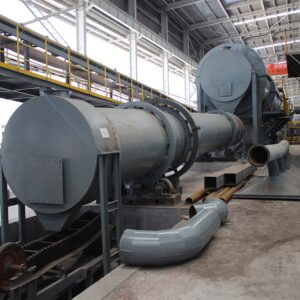
The most common type of ore dryer machine is the Rotary Dryer. Its operation is both simple and highly effective:
Feeding: The wet ore is fed into the elevated end of a slightly inclined, rotating cylindrical drum.
Drying Zone: As the drum rotates, the material is lifted by a series of internal flights (lifters) and cascaded through the drum’s interior.
Heat Transfer: A hot gas stream, generated by a furnace or burner, flows through the drum. This stream can flow concurrently (same direction as the ore) or counter-currently (opposite direction), efficiently transferring heat to the ore particles and evaporating the moisture.
Discharge: The now-dry ore exits at the lower end of the drum. The evaporated moisture and exhaust gases are treated in a dust collection system (like a baghouse or cyclone) before being released, ensuring environmental compliance.
Key Features and Advantages of Our Ore Dryer Machines
Our ore drying equipment is built for performance, durability, and maximum return on investment.
High Thermal Efficiency: Advanced design ensures optimal heat transfer, minimizing fuel consumption and operational costs.
Robust Construction: Built with high-quality, wear-resistant materials to withstand the abrasive nature of ores, ensuring a long service life.
Customizable Lifters & Drum: The internal flight design can be customized for different ore characteristics to achieve the best cascading action and drying efficiency.
Precise Temperature Control: Advanced control systems allow for precise regulation of temperature and residence time, preventing over-drying and protecting ore quality.
Low Maintenance: Simple design with easy access to components reduces downtime and maintenance costs.
Uniform Drying: The tumbling action ensures every particle is exposed evenly to the heat source, resulting in a consistently dry product.
Ore Dryer Machine: Heat Source Selection and Comparison
| Heat Source | Advantages | Disadvantages | Best For |
|---|---|---|---|
| Natural Gas / Diesel | Clean combustion, easy to control, high efficiency. | Higher fuel cost, requires gas pipeline or storage. | Most applications where fuel is readily available. |
| Coal | Very low-cost fuel. | Produces ash, requires a complex combustion system, higher emissions. | Large-scale operations in regions with cheap coal. |
| Biomass | Renewable, low cost if locally available, carbon-neutral. | Inconsistent fuel quality, requires more storage space. | Sustainable operations near biomass sources. |
| Waste Heat | Lowest operating cost, utilizes excess heat from other processes. | High initial investment for heat recovery system, depends on availability. | Plants with kilns, furnaces, or power generators. |
| Electricity | Very clean, precise control, easy installation. | Highest operational cost, limited by power capacity. | Small-scale operations or areas with strict emission controls |
We Provide FULLY CUSTOMIZED Ore Dryer Solutions
We understand that every mining operation is unique. There is no true “one-size-fits-all” solution. Therefore, we specialize in designing and manufacturing custom ore dryer machines to meet your specific requirements.
Our engineering team will work with you to design a dryer based on:
Your Ore Type & Characteristics: (Abrasiveness, particle size, initial moisture)
Required Throughput: (Tons per hour)
Initial and Target Moisture Content:
Available Heat Source:
Available Plant Space and Layout:
Contact us today for a free consultation. Let our experts provide you with a tailored solution that maximizes your drying efficiency and profitability.