
Biochar Dryer
The Best Choices for Your Project
- Customization Service:The maximum customizable diameter is 3.5 meters
- Solution:Provide solutions for your problems
- Dryer length: 8 meters to 50 meters.

Biochar Dryer
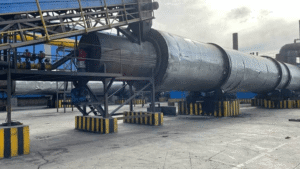
The biochar drying process utilizes controlled heat and airflow to evaporate moisture from the material. In a rotary biochar dryer, the biochar is fed into a rotating drum, where it is exposed to hot air generated by a heating system. The tumbling action ensures even drying, while exhaust systems remove humid air. This method guarantees efficient moisture removal without compromising the biochar’s structural integrity.
The coal rotary dryer operates by feeding wet coal into a rotating drum, which is slightly inclined. Hot air or combustion gases flow through the drum, either in the same direction (co-current) or opposite direction (counter-current) to the coal. As the drum rotates, the coal is lifted by internal fins and cascaded down through the hot air, ensuring even and efficient drying. The dried coal is then discharged from the other end.
Biochar Dryer Models & Technical Parameters
Below is a summary of our standard biochar dryer models. All parameters can be customized based on your specific raw material, moisture content, and production requirements.
| Model Parameter | BCD-500 (Pilot/Small Scale) | BCD-1000 (Standard Medium Scale) | BCD-2000 (Large Industrial Scale) | BCD-3000 (Heavy-Duty Scale) |
|---|---|---|---|---|
| Recommended Evaporation Capacity (kg H₂O/h) | 500 | 1,000 | 2,000 | 3,000+ |
| Recommended Biochar Output (kg/h)* | ~ 250 – 400 | ~ 500 – 800 | ~ 1,000 – 1,600 | ~ 1,500 – 2,400 |
| Drum Dimensions (Diameter × Length) | Ø1.2m × 8m | Ø1.8m × 12m | Ø2.2m × 18m | Ø2.6m × 22m |
| Operating Temperature | Up to 450°C | Up to 450°C | Up to 450°C | Up to 450°C |
| Inlet Moisture (Max) | 45% | 45% | 50% | 50% |
| Outlet Moisture | Adjustable, typically <15% | Adjustable, typically <15% | Adjustable, typically <10-15% | Adjustable, typically <10-15% |
| Rotary Speed | 1-8 rpm (Variable Frequency Control) | 1-8 rpm (Variable Frequency Control) | 1-8 rpm (Variable Frequency Control) | 1-8 rpm (Variable Frequency Control) |
| Heat Source Options | Natural Gas, Biomass, Diesel, Electric, Steam | Natural Gas, Biomass, Diesel, Coal, Steam | Natural Gas, Biomass, Diesel, Coal, Waste Heat | Natural Gas, Biomass, Coal, Waste Heat |
| Total Installed Power (kW) | ~ 15 – 20 | ~ 30 – 45 | ~ 75 – 100 | ~ 110 – 150 |
| Footprint (Length × Width) | ~ 12m × 5m | ~ 18m × 7m | ~ 25m × 9m | ~ 30m × 10m |
Notes & Explanations:
Recommended Biochar Output: This is an estimated range. The final output highly depends on the initial moisture content of your biochar. Higher inlet moisture will reduce the final product output.
Customization: This table lists standard models. We specialize in providing tailored solutions. We can adjust the drum size, heating system, and other features to perfectly match your:
Required Production Volume
Specific Inlet and Outlet Moisture Levels
Available Heat Source
Site Space Limitations
Why Choose Our Rotary Biochar Dryer?
High Efficiency: Specially designed lifting flights inside the drum ensure optimal heat transfer and uniform drying.
Durability: Manufactured with high-temperature resistant materials for longevity when handling abrasive biochar.
Energy Flexible: Can be configured to use the most cost-effective and available heat source for your operation.
Turnkey Solutions: We provide complete system design, manufacturing, installation, and commissioning support.
Key Features of Biochar Dryer
High Thermal Efficiency: Optimized heat exchange minimizes energy consumption.
Uniform Drying: Rotating drum design ensures consistent moisture reduction.
Versatile Heating Options: Compatible with multiple heat sources (e.g., biomass, natural gas, steam).
Eco-Friendly Operation: Reduces dust emissions and supports sustainable biochar production.
Customizable Workflow: Tailored drying solutions based on moisture levels and output requirements.
What Other Materials Can a Biochar Dryer Process?
Beyond biochar, our dryer efficiently handles:
Wood chips and sawdust
Agricultural waste (e.g., rice husks, straw)
Sludge and organic fertilizers
Mineral powders and industrial by-products
Advantages of Our Rotary Biochar Dryer
Rapid Drying: Enhanced airflow and heat distribution reduce processing time.
Durability: Robust construction ensures long-term reliability under high temperatures.
Flexible Configuration: Customizable drum speed, temperature, and retention time.
Energy-Saving Design: Recycled heat utilization lowers operational costs.
Key Considerations for Drying Biomass
Moisture Content: Initial and target moisture levels determine drying time and energy use.
Particle Size: Uniform sizing promotes even drying.
Temperature Control: Excessive heat may degrade biochar quality.
Safety Measures: Fire and dust explosion risks require advanced prevention systems.
Available Heat Sources for Biochar Dryer
Our dryers support diverse heating methods:
Biomass Burners: Sustainable option using agricultural residues.
Natural Gas/Propane: Clean and efficient.
Steam Heat Exchangers: Ideal for moisture-sensitive materials.
Electric Heaters: Precise temperature control for small-scale operations.
How to Dry Biochar Quickly?
Pre-Crushing: Reduce biochar particle size for faster moisture evaporation.
High-Temperature Airflow: Increase thermal input while avoiding combustion risks.
Optimized Drum Speed: Adjust rotation to maximize material exposure to heat.
Moisture Monitoring: Real-time sensors ensure timely process adjustments.
Why Choose Our Rotary Biochar Dryer?
Our rotary dryers excel in:
High Capacity: Designed for large-scale industrial output.
Adaptability: Suitable for diverse biochar types and moisture levels.
Turnkey Solutions: End-to-end support from design to installation.
Customized Biochar Dryer Solutions
We provide personalized biochar drying systems based on:
Production Capacity: From pilot-scale to industrial volumes.
Initial Moisture Content: Customized drying cycles for optimal efficiency.
Space and Budget Constraints: Flexible designs to meet specific needs.