
Automatic Rotary Dryer
The Best Choices for Your Project
- Customization Service:The maximum customizable diameter is 3.5 meters
- Solution:Provide solutions for your problems
- Dryer length: 8 meters to 50 meters.
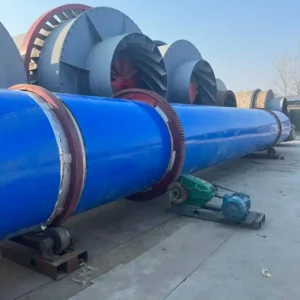
Automatic Rotary Dryer: A Comprehensive Overview
An Automatic Rotary Dryer is an industrial drying system designed to reduce moisture content in bulk materials through a continuous, automated process. It consists of a rotating drum, heating source, feeding mechanism, and discharge system, all integrated with smart controls for minimal manual intervention. Widely used in mining, agriculture, chemical, and waste recycling sectors, it efficiently handles materials like sand, sludge, minerals, and biomass.
Key Features of Automatic Rotary Dryer
Robust Construction: Made from high-grade steel with anti-corrosion coatings for durability.
Rotating Drum with Lifter Blades: Ensures material is evenly lifted and showered through hot air for uniform drying.
Smart Control Panel: Monitors temperature, speed, and moisture levels in real-time for precise adjustments.
Insulated Design: Minimizes heat loss, improving energy efficiency.
Dust Removal Systems: Integrated cyclones or bag filters to meet environmental standards.
Advantages of Automatic Rotary Dryer
High Efficiency: Rapid drying with consistent results, boosting production output.
Low Labor Costs: Fully automated operation reduces manual oversight.
Energy Savings: Optimized heat distribution and recycling cut fuel consumption.
Versatility: Adaptable to diverse materials and moisture levels.
Low Maintenance: Simple design with accessible parts extends service life.
Working Principle of Automatic Rotary Dryer
Wet material is fed into the rotating drum, where lifters cascade it through a stream of hot air generated by a burner or heater. As the drum rotates, moisture evaporates, and dried material moves toward the discharge end. Airflow direction (co-current or counter-current) is adjusted based on material properties to maximize efficiency.
Materials Processed by Automatic Rotary Dryer
Ores and Minerals: Iron sand, copper concentrate, limestone.
Agricultural Products: Grains, forage, wood chips.
Industrial Waste: Sludge, sediment, chemical by-products.
。Recyclables: Plastic flakes, municipal solid waste.
。Construction Materials: Sand, gravel, clay.
Heat Source Options for Automatic Rotary Dryer
Natural Gas/Propane: Clean and cost-effective for most applications.
Diesel/Oil: Suitable for remote areas without gas infrastructure.
Biomass: Eco-friendly option using wood chips or agricultural waste.
Electric Heating: Ideal for small-scale or precise temperature control needs.
Steam: Used in industries where steam is already available.
Fully Automated Process: Feeding, Drying, and Discharge
Feeding: Belt or screw conveyors transport material into the drum, with rate controlled by sensors.
Drying: Sensors monitor internal temperature and moisture, adjusting drum speed and heat automatically.
Discharge: Dried material is cooled and conveyed to storage, while dust collectors clean exhaust air.
Customization and Selection of Automatic Rotary Dryer
Material Analysis: Provide sample details (moisture, particle size, abrasiveness) for tailored designs.
Capacity Requirements: Choose from small (1–5 tons/hour) to large (50+ tons/hour) systems.
Heat Source Preference: Select based on local fuel availability and cost.
Space Constraints: Compact designs for limited areas.
Budget Considerations: Balance upfront cost with long-term efficiency.
Custom-Built Automatic Rotary Dryers
We engineer dryers to meet specific client needs, including:
Size Modifications: Adjust drum length/diameter for optimal retention time.
Specialized Linings: Wear-resistant or anti-stick coatings for abrasive/sticky materials.
Advanced Controls: IoT-enabled monitoring for remote operation.
Additional Features: Add-ons like crushers or coolers for integrated processing.
Output Capacity of Automatic Rotary Dryer
Output varies from 1 ton/hour for pilot plants to over 100 tons/hour for large industrial setups. Factors affecting capacity include material type, initial moisture, and heat source efficiency. We provide test runs to guarantee desired results.