
Continuous Rotary Dryer
Continuous Rotary Dryer is a large-scale industrial drying machine designed for continuous drying of biomass materials and bulk materials. It is widely used for drying sawdust, wood chips, bamboo chips, rice husk, palm fiber, EFB, agricultural waste, and other materials before pelletizing, briquetting, carbonization, and further processing.
According to different raw materials, moisture content, and required capacity, we provide customized rotary dryer solutions with different drum diameters, lengths, heating systems, and dust collection systems.
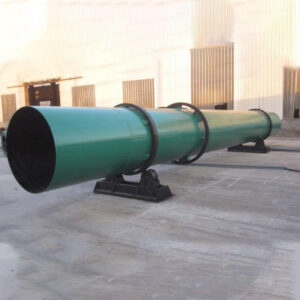
Table of Contents
What Is a Continuous Rotary Dryer?
A continuous rotary dryer is an industrial drying machine designed for continuous feeding, drying, and discharging of materials. Different from batch drying equipment, the rotary dryer can operate continuously with stable capacity, making it suitable for large-scale production lines.
The material enters the rotating drum through the feeding system. During the rotation process, the material is continuously lifted and scattered by internal lifting flights, allowing full contact with hot air. The moisture is gradually evaporated and removed through the exhaust system.
Continuous rotary dryers are widely used in biomass processing, renewable energy production, agricultural waste treatment, mineral processing, chemical industries, and other applications requiring efficient moisture control.
2. Continuous Rotary Dryer Applications
Our continuous rotary dryers are widely used for drying biomass materials before pelletizing, briquetting, carbonization, or further processing.
Suitable materials include:
- Sawdust
- Wood chips
- Bamboo chips
- Rice husk
- Palm fiber
- Empty fruit bunch (EFB)
- Corn stalk
- Straw
- Bagasse
- Coconut shell
- Peanut shell
- Agricultural residues
For biomass carbonization projects, the rotary dryer can reduce raw material moisture to improve carbonization efficiency, reduce energy consumption, and achieve more stable biochar quality.
3. Advantages of Continuous Rotary Dryer
Efficient Continuous Operation
The rotary dryer is designed for continuous feeding and automatic discharge, reducing manual operation requirements and improving production efficiency.
Customized Heat Source Options
The drying system can use different heat sources according to customer requirements:
- Biomass burner
- Natural gas
- Diesel
- Hot air furnace
- Waste heat recovery system
- Carbonization furnace exhaust gas
For biochar production projects, the heat generated during biomass carbonization can be recovered and used as a drying heat source, reducing operating costs.
4. Continuous Rotary Dryer Features
- Continuous operation with stable capacity
- Large processing capacity for industrial production
- Adjustable drying temperature and residence time
- High thermal efficiency
- Customized drum diameter and length
- Suitable for different moisture levels
- Automatic feeding and discharging system
- Designed according to customer’s raw materials
5. Rotary Dryer Working Principle
The continuous rotary dryer uses hot air as the drying medium. When materials enter the rotating drum, lifting plates inside the drum continuously raise and drop the materials, creating a curtain-like movement.
The hot air passes through the material layer, transfers heat, and removes moisture. The dried material is discharged continuously from the outlet.
6. Why Choose Our Continuous Rotary Dryer?
As a professional drying equipment manufacturer, we provide complete drying solutions based on customer’s raw materials, moisture content, required capacity, and available energy sources.
Before manufacturing, we can analyze your material characteristics and recommend suitable drying systems, including dryer size, heating system, feeding method, and dust collection equipment.
Our goal is to help customers achieve stable production, lower energy consumption, and long-term reliable operation.
Rotary Dryer for Wood Powder in Biomass Pellet Production
Wood powder and sawdust are commonly used in biomass pellet production.
However, the raw material moisture must usually be controlled before pelletizing.
The production process may include:
Wood Waste
↓
Wood Crusher
↓
Wood Powder
↓
Rotary Dryer
↓
Dried Wood Powder
↓
Pellet Machine
↓
Biomass Pellets
A properly designed drying system can help create more stable conditions for the pellet production process.
How to Select the Right Rotary Dryer for Wood Powder?
When selecting a wood powder rotary dryer, several technical factors should be considered.
1. Raw Material Type
Different wood materials have different characteristics.
For example:
- Sawdust
- Wood flour
- Wood powder
- Wood chips
These materials may require different airflow and feeding designs.
2. Initial Moisture Content
The initial moisture content is one of the most important factors.
For example:
Initial Moisture: 40%
↓
Drying
↓
Final Moisture: 10%–15%
The higher the initial moisture, the more water must be removed.
This directly affects:
- Dryer size
- Heat consumption
- Processing capacity
- Equipment configuration
3. Required Final Moisture
Different applications require different moisture levels.
For example:
Biomass Pellet Production
Often requires controlled moisture for stable pelletizing.
Carbonization
Lower moisture can reduce unnecessary heat consumption.
Storage
Reduced moisture can improve storage conditions.
4. Processing Capacity
The customer should determine the required hourly processing capacity.
For example:
- 500 kg/h
- 1 ton/h
- 2 ton/h
- 5 ton/h
- 10 ton/h
The dryer size should be selected according to the actual processing requirement.
5. Available Fuel Source
The local energy source should also be considered.
Different regions may have different fuel costs.
Available options may include:
- Biomass
- Natural gas
- Diesel
- LPG
- Coal
- Electricity
Selecting an appropriate heat source can help reduce operating costs.
Technical Information Required for Dryer Selection
Before recommending a rotary dryer, we usually suggest confirming the following information.
Raw Material
What material will be dried?
Initial Moisture Content
What is the moisture content before drying?
Final Moisture Content
What moisture level is required after drying?
Processing Capacity
How many tons per hour need to be processed?
Particle Size
What is the size of the wood powder or sawdust?
Heat Source
What fuel is available locally?
Final Application
What will the dried material be used for?
For example:
- Biomass pellets
- Biochar
- Charcoal briquettes
- Activated carbon
- Biomass fuel
- Industrial processing
With this information, the dryer system can be designed more accurately.
Why Choose a Customized Wood Powder Drying System?
There is no single dryer configuration suitable for every wood powder project.
For example, two customers may both require a capacity of 3 tons per hour, but their actual requirements may be completely different.
Customer A
- Initial moisture: 20%
- Final moisture: 12%
- Material: Sawdust
Customer B
- Initial moisture: 50%
- Final moisture: 10%
- Material: Fine wood powder
Although the processing capacity may be similar, the amount of water that needs to be removed is completely different.
Therefore, the rotary drum size, heating system and airflow design should be customized according to the actual project.
Continuous Rotary Dryer Model & Technical Parameters
| Model | Drum Diameter (mm) | Drum Length (m) | Capacity | Input Moisture | Output Moisture | Power |
|---|---|---|---|---|---|---|
| KSR-RD1200 | 1200 | 8-12 | 0.5-1.5 t/h | 30-60% | 10-15% | 15-30 kW |
| KSR-RD1500 | 1500 | 10-15 | 1.5-3 t/h | 30-60% | 10-15% | 30-45 kW |
| KSR-RD1800 | 1800 | 12-18 | 3-5 t/h | 30-60% | 10-15% | 45-75 kW |
| KSR-RD2200 | 2200 | 15-22 | 5-10 t/h | 30-60% | 10-15% | 75-110 kW |
| KSR-RD2800 | 2800 | 18-28 | 10-20 t/h | 30-60% | 10-15% | 110-160 kW |
| KSR-RD3200 | 3200 | 25-30 | 20-30 t/h | 30-60% | 10-15% | 160-220 kW |