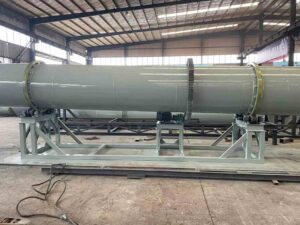
Unlocking Precision Drying: The Full Framework for Tailoring Rotary Dryer Design
Say goodbye to those pre-made drying solutions that force you to choose between fast and good. If some things possess odd nature, or particular results are expected by the process, then selecting a particular rotary drier design is not a choice but it becomes the important part of the engineering strategy to have better results with most dependability and profit. Alright with all this being our map we’re heading down the road of picking out, making and sourcing a dryer just for you.
What's a Rotary Dryer?
On the lowest portion is a rotary drier which would be considered to be quite a strong piece of industry, being lovingly made to strip away the moisture out of vast volumes of material via very regulated warmth. Works with a tilted cylindrical drum that is a little. As it spins, the material is taken up by internal lifters known as flights and cascaded through a stream of hot air or gases, which allows for better surface exposure to increase the rate of evaporation. This sort of thing is rather ordinary, but it proves very practical sort of a system which has become an essential feature throughout many industries such as minerals, farmlands, factories for chemicals, and with biodegradable items.
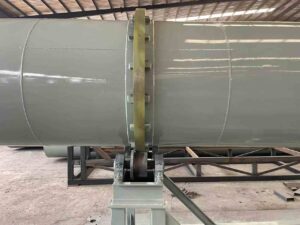
Types of Rotary Dryer Design
It is its own self it sticks by as for various kinds of work it tinkers with different sensitivities of matter and intentions to process:
Direct-Heat Rotary Dryers: The industry’s backbone. The material is directly in contact with hot combustion gases flowing through the drum. Especially suitable for materials like sand, ores, and aggregates which do not have combustibility and also have good thermal stability and the pollution issue is ignored.
Indirect-Heat Rotary Dryers: via the drum shell (via surrounding jacket) or internal heating tubes. This design is a protective barrier and is therefore very suitable for fine powders, flammable materials, or products that come into contact with combustion gases and thus become contaminated or deteriorated, such as some chemicals and food products.
Direct-Indirect Combination Dryers: The dryers use both methods. Usually the first zone is heated with direct heat and the second zone is heated with indirect heat. Like this drying processes especially with some filter cakes or sludges need very good thermal efficiency and also very exact control on complicated drying curves, but those systems can do.
Rotary Coolers & Kilns: The principle of the rotating drum is used in both cases – in cooling the hot, dried material with the use of the surrounding air (coolers), and in causing chemical reactions at elevated temperatures, e.g., calcination (kilns).

Why must we have Tailored Design?
Standard dryers are made for average conditions and materials. To fill the gap between a general-purpose tool and a precision instrument, by tailoring the design. And why does it matter?
The king was material behavior: a tarry phosphateslime wouldn’t dry up the water, or the free-flowing silica-sand. The exact drum speed, flight pattern, and heat profile are due to being customized for particles size distribution, initial moisture bonding, abrasiveness, thermal sensitivity, and flow characteristics.
Optimizing the Entire Process: More than just getting rid of the water. Custom fit with retention periods, temperature changes, ventilation effects to meet certain moisture levels, preserving calorific measures, dietary values or particle construction that hugely change how much the finished project would be worth from start to finish.
Conquering Site & Integration Hurdles: We consider all aspects: physical space, headroom, feed and discharge points, existing burner connection or dust collection system connection. They are all included in your custom design, to blend nicely into your plant’s existing ecosystem.
What Client Requirement Related Difficulties are Resolved by Custom Design?
A carefully planned dryer that is made to address and completely solve continual operational troubles:
Product integrity & value: thermal degradation, too much drying which may harm the material’s structural strength or dirt that spoils the quality and market worth of the item can all be avoided.
Slashes Oper Expenditure: By way of a wear – optimized design, it is possible to achieve the best fuel efficiency and reduce the time that is lost due to either accumulated material or mechanical failure, and extend the life of the component.
Future-Proofs Your Investment: With some margin for possible future upscaling included in the design, a total replacement will not be required when the production volume rises.
Guarantees Regulatory Compliance: For engineers to comply with the local environment and workplace regulations, they are able to add in the feature of controlling emissions, dust containment, and safety systems.
How to Evaluate and Choose the Optimal Design Partner
Picking a fabricator is tricky. Step beyond the glitzy pamphlets to see if their true engineering meat is any good:
Require Proof of Engineering Profundity: Project profiles need to be given completely instead of equipment lists only. How do they solve a specific sticking point? What calculations were used to find the L/D of the drum? What sort of approach is shown for problem solving from their response.
Prioritize Process Testing Capability: A partner who has a pilot testing lab is a partner I want to have. When you run a small-scale test on your material, you’re gathering something that’s unimpeachable when it comes to your drying kinetics, your airflow needs, and what the final quality will be, and that turns what was once the riskiest part of the whole capital project into a low-stakes situation by a lot.
Examine Their Project Implementation Framework: Can the truly give full range from the lab to launch. A dedicated PM? Clear channels of communciation and single point of accountability is very importnat for complex custom project.
Evaluate Build Quality & Standards: As for the standard shell thickness, the engineering software used in stress analysis, welding procedures such as ASME code, and the quality of auxiliary components like gearboxes, bearings, and motors, ask questions. If you can go to their workshop.
Frequently asked questions on the design of custom rotary dryers
Q: The first and most important step for starting a custom dryer project is?
A: Usually, the most useful starting point is a laboratory moisture analysis and feasibility study done by the manufacturer. Provide them with a sample of 20-50kg before you even start any designs. It gives them a full understanding of your materials drying characteristics.
Q: What sort of long-term value proposition can justify the upfront premium price of a customized design?
A: Make the cost an investment, not an expense. The premium is ascribed to the advantage in energy usage, improved throughput, reduced production waste, lowered maintenance burden, and preventing production downtime. ROn\\ general its measured in montners not years.
Q: Can you upgrade our aging under performing rotary dryer rather than replacing it?
A: Sure. A common and reasonable path is a performance enhancement retrofit. It can involve redesigning and rebuilding the internal flight system, adding or upgrading insulation, adding a new high-efficiency burner or heat source, upgrading the control system, etc., and often rejuvenating and modernizing an old dryer.
A: The most common errors to avoid when specifying a custom dryer?
A: By far the greatest trap is to provide incomplete or vague information about your material and process goals. Second, when choosing a vendor the vendor who has shown good engineering skill, and total cost of the system over its life. This cost is not just the initial price. First, always do some thorough tests with materials.