
Rotary Dryer for Straw: Drying Solutions for Biomass Processing
Straw is widely available in agricultural areas, but using it for industrial production often requires some preparation before it can enter the next processing stage. Moisture content, fiber structure, particle size and feeding conditions can all affect how straw behaves during drying and subsequent processing.
A rotary dryer for straw is designed to reduce moisture in prepared agricultural residues through a continuous drying process. It can be used in biomass fuel production, straw pellet manufacturing, briquetting plants and other applications where more consistent raw material moisture is required.
The right drying system depends on the straw being processed, its initial moisture content, the required output moisture, and the capacity of the production line. These factors should be considered before selecting a rotary drum dryer.
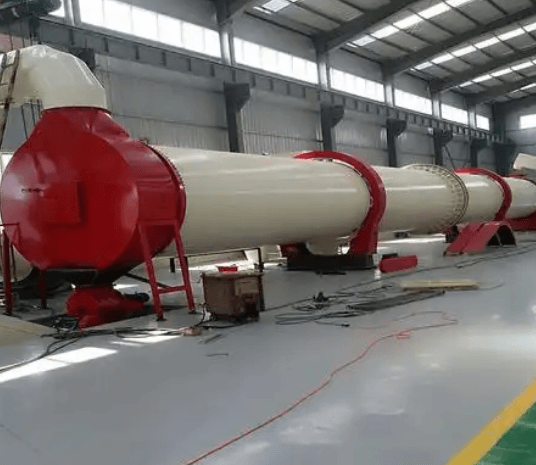
Table of Contents
What Is a Rotary Dryer for Straw?
A straw rotary dryer is an industrial drying machine that uses a rotating drum to move material through a drying chamber. As the drum rotates, the straw is gradually conveyed toward the discharge end while coming into contact with the drying gas or heated surfaces, depending on the dryer design.
In a typical direct-heating rotary dryer, hot gas passes through the drum and transfers heat to the material. Internal lifting flights help lift and distribute the material, increasing its exposure to the drying gas. The dried material is then discharged for collection or further processing.
The complete system may include a feeding conveyor, rotary drum, heat source, induced-draft fan, dust collection equipment and a discharge conveyor. The exact configuration depends on the raw material, plant layout and environmental requirements.
Straw is different from many dense granular materials. It can be lightweight, fibrous, irregular in shape and difficult to feed consistently. Long pieces may tangle or bridge in hoppers, while excessive fines can increase dust generation. For this reason, the feeding arrangement and material preparation system deserve as much attention as the dryer itself.
Which Types of Straw Can Be Dried?
A properly selected rotary drying system may be suitable for several types of agricultural straw. However, different materials behave differently during drying, and the same machine settings should not automatically be used for every feedstock.
Wheat Straw
Wheat straw is commonly considered for biomass fuel, pellet production, briquetting and agricultural residue processing.
Its long fibers and relatively low bulk density can make feeding and material distribution challenging. Depending on the intended use, the straw may need to be chopped or otherwise prepared before entering the dryer.
For wheat straw pellet production, the drying system should be selected according to the pellet mill’s moisture requirements, the initial moisture of the straw and the required hourly output.
Rice Straw
Rice straw is generated in large quantities in rice-growing regions and may be used in biomass fuel, densified fuel and other agricultural residue applications.
Rice straw can contain a mixture of fine and long fibrous particles, depending on harvesting and chopping methods. Soil, sand and other contaminants may also enter with the raw material.
A suitable rice straw drying system should account for feed consistency, dust collection, material handling and the required moisture level after drying.
Corn Stalks and Other Crop Residues
Corn stalks, barley straw and similar agricultural residues may also be processed in biomass preparation plants.
These materials often need size reduction before drying. Their moisture content, bulk density and fiber length can vary considerably between farms, harvest periods and storage conditions.
Before choosing a rotary dryer, it is useful to confirm the actual feedstock condition rather than relying only on the material name.
How Does a Straw Rotary Dryer Work?
A rotary drying system typically follows several stages.
1. Raw Material Feeding
Prepared straw is delivered to the dryer through a conveyor or another suitable feeding device. A stable feed rate helps maintain consistent operation.
Long fibers, large bundles and irregularly sized material should be considered when selecting the hopper, conveyor and feeding mechanism.
2. Heat Supply
Heat is supplied by a suitable hot-air furnace, burner or other compatible heat source. The choice depends on the plant’s available fuel, operating cost, local regulations and required drying performance.
The heat source should be matched to the moisture load and required throughput. Excessive heat does not necessarily mean better drying, particularly when the material can be damaged or exposed to a fire risk.
3. Drying Inside the Rotating Drum
As the drum rotates, internal lifting flights help move and distribute the straw through the drying zone.
The material gradually loses moisture as heat is transferred to it. Drum speed, inclination, gas temperature, airflow, material loading and residence time all influence the drying result.
Straw with inconsistent size or moisture may require adjustments to the operating conditions to achieve a stable output.
4. Discharge and Dust Collection
Dried straw is discharged for cooling, storage or further processing. A suitable dust collection system helps capture entrained particles and manage dust from the drying process.
The final arrangement should be designed around the actual material, plant layout and applicable environmental and fire-safety requirements.
Why Dry Straw Before Pelletizing or Briquetting?
Moisture control is an important part of preparing biomass for densification.
When straw moisture is too high for the selected pelletizing or briquetting process, it can affect feeding, forming performance, finished product quality and the energy required by downstream equipment. Moisture that is too low can also be undesirable, depending on the material and process.
A rotary dryer can help bring prepared straw closer to the target moisture range required by the next production stage.
For a straw pellet production line, the drying stage may be positioned after initial size reduction and before final milling or pelletizing, depending on the process design.
The required moisture level should be determined from the pellet mill or briquetting machine requirements, the characteristics of the straw and the desired finished product. There is no single moisture target that is appropriate for every straw processing project.
How to Select an Industrial Straw Drying Machine
Selecting a rotary dryer should start with the actual operating conditions rather than the drum dimensions alone.
Initial and Final Moisture Content
Measure or estimate the incoming straw moisture and specify the desired moisture at the dryer outlet. These values are essential for calculating the water removal requirement.
For example, material arriving after rainfall may require a different drying duty from straw that has been stored under cover.
Processing Capacity
Specify the required feed rate in kilograms per hour or tonnes per hour, and clarify whether the figure refers to wet feed or dried output.
A stated capacity without a corresponding initial and final moisture content may not accurately describe the dryer’s performance.
Particle Size and Fiber Length
Chopped straw and long, unprocessed stalks do not flow through equipment in the same way. Particle size reduction, screening or other preparation may be necessary to improve feeding and material distribution.
Heat Source and Energy Consumption
The available heat source and its cost can have a major effect on operating expenses. When comparing proposals, ask for the expected fuel consumption, electrical power and the conditions under which these figures are calculated.
Energy use should be evaluated against the actual water removal requirement, not just the rated motor power.
Dust Control and Operating Safety
Drying agricultural residues requires attention to dust, hot surfaces, ignition sources and material buildup. The system should include suitable monitoring, cleaning access and safety measures based on the material and installation conditions.
The appropriate dust collection and fire-protection arrangements should be assessed for the specific plant.
Can a Rotary Dryer Be Integrated into a Straw Pellet Production Line?
Yes. A rotary dryer can be used as one stage of a complete biomass preparation and pelletizing system.
A typical process may include:
Straw collection and preliminary cleaning
Chopping or size reduction
Drying to the required moisture range
Further milling or screening, if needed
Pelletizing or briquetting
Cooling, screening and finished product handling
The exact sequence depends on the condition of the incoming straw and the requirements of the downstream equipment.
Integrating the dryer with conveyors, feeders, dust collection and the control system can help coordinate material flow across the production line. When designing the layout, allow sufficient space for maintenance, cleaning and inspection.
Common Questions About Straw Rotary Dryers
What moisture content should straw have before pelletizing?
The required moisture content depends on the straw type, pellet mill design and production process. The target should be confirmed with the downstream equipment supplier and verified through material testing.
Can a rotary dryer handle wet straw?
A suitable system can be designed for straw with different initial moisture levels. However, the required capacity depends on how much water must be removed, the feed rate, the available heat and the material’s physical condition.
Is chopped straw easier to dry than long straw?
Chopped straw is generally easier to feed and distribute consistently than long, tangled fibers. The appropriate particle size depends on the complete processing line, so material preparation should be evaluated together with the dryer.
What information is needed to select a straw dryer?
The most useful details are the type of straw, initial moisture content, target outlet moisture, required capacity, particle size, available heat source and intended application.
Can the dryer be customized for different biomass materials?
The system configuration can be evaluated for different biomass feedstocks. Wheat straw, rice straw, corn stalks and other residues may require different feeding, drum and dust-handling arrangements. Material testing and process calculations are recommended before finalizing the equipment.
Looking for a Rotary Dryer for Straw?
Every straw drying project starts with different raw material conditions and production requirements.
To evaluate a suitable rotary dryer, share the type of straw you process, its approximate initial moisture content, the target moisture after drying and your required capacity. Information about particle size, available fuel and the downstream process is also helpful.
Our team can use these details to assess the drying duty and discuss a suitable equipment configuration for your biomass processing project.
Contact us to discuss your straw drying requirements and the next stage of your production process.
Frequently Asked Questions About Rotary Dryers for Straw
1. What types of straw can a rotary dryer process?
A suitably designed rotary dryer may be used for wheat straw, rice straw, corn stalks and other agricultural residues. The required configuration depends on the material’s moisture content, fiber length, particle size and processing capacity. Some materials may need chopping or other preparation before drying.
2. What is the suitable moisture content for straw after drying?
The target moisture content depends on the intended application. Straw for pellet production, briquetting or other biomass processing may require different moisture levels. The target should be confirmed according to the requirements of the downstream equipment and the characteristics of the raw material.
3. Can a rotary dryer handle wet straw?
Yes, a rotary dryer can be designed to handle straw with relatively high moisture content, provided its capacity and heat supply are suitable for the required water removal. The initial moisture content, target outlet moisture and hourly feed rate must be considered when selecting the equipment.
4. What is the capacity of a straw rotary dryer?
The processing capacity depends on the dryer design, straw characteristics, initial moisture content and required outlet moisture. When requesting a quotation, specify whether your required capacity refers to wet raw material input or dried material output. This helps ensure that different equipment proposals can be compared on the same basis.
5. Can a straw rotary dryer be used for biomass pellet production?
Yes. A rotary dryer can be integrated into a biomass pellet production line to reduce raw material moisture before further milling and pelletizing, where required. The complete process may include chopping, drying, size reduction, pelletizing, cooling and finished product handling.
6. What heat sources can be used for a rotary straw dryer?
The available heat source depends on the dryer design, plant requirements and local fuel availability. Options may include a suitable biomass-fired hot-air furnace, gas burner or other compatible heating system. The heat source should be selected according to the required drying duty, operating cost and applicable environmental and safety requirements.
7. How can the energy consumption of a straw dryer be estimated?
Energy consumption depends mainly on the amount of water to be removed, heat losses, heat source efficiency, exhaust conditions and operating settings. Electrical consumption from fans, conveyors and the drum drive should also be considered. An estimate should be based on the actual feed rate and initial and final moisture contents rather than rated motor power alone.
8. Does straw need to be chopped before entering a rotary dryer?
Not every application requires the same preparation process, but long straw can be difficult to feed and distribute consistently. Chopping may improve material handling and drying consistency. The appropriate particle size should be determined according to the feeding system, dryer design and downstream processing requirements.
9. What information is needed to select a rotary dryer for straw?
To evaluate a suitable machine, provide the following information:
Straw type, such as wheat straw or rice straw
Initial moisture content
Required moisture content after drying
Required capacity in kg/h or t/h
Straw length and particle size
Available heat source or fuel
Intended application, such as pelletizing or briquetting
These details help establish the drying requirement and determine a suitable equipment configuration.
10. Can a rotary dryer be customized for different straw processing projects?
The equipment configuration can be evaluated according to the raw material, moisture reduction requirement, capacity and plant layout. Feeding conveyors, heat supply, dust collection and discharge systems may need to be adapted to the project. For materials with unusual fiber characteristics or moisture levels, material testing is recommended before final equipment selection.
Request a Rotary Dryer for Straw Solution
Planning a straw drying project? Tell us what type of straw you process, its initial moisture content, your target outlet moisture and the capacity you need.
With this information, we can discuss a suitable rotary drying system for your biomass processing or pellet production project.
Contact us to discuss your straw drying requirements.