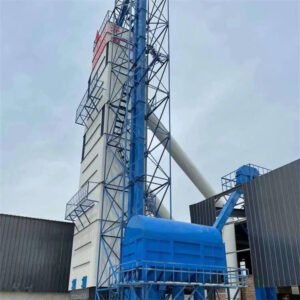
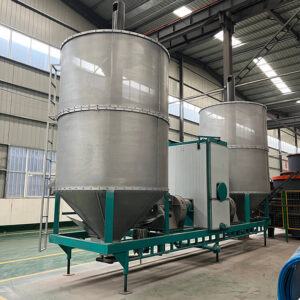
rice dryer
The Best Choices for Your Project
Provide you with rotary kiln dryer solutions
- Customization Service:The maximum customizable diameter is 3.5 meters
- Solution:Provide solutions for your problems
- Dryer length: 8 meters to 36 meters.
rice dryer
A rice dryer is a specialized machine for drying rice. Its unique design allows it to quickly dry rice to a level below the safe storage limit. It replaces traditional drying methods by airing rice in the sun, achieving industrialized drying.
Rice dryers are available in large and small sizes, and can be customized as mobile dryers.
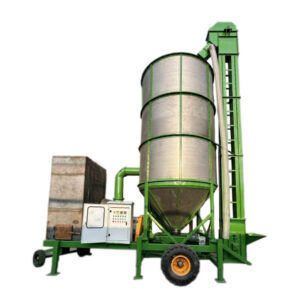
The rice dryer uses a circulating hot air drying principle: wet rice enters the drying tower via an elevator. The hot air, driven by a fan, penetrates the rice layer, removing moisture. During the drying process, the rice slowly flows downward. Multiple temperature and humidity control steps ensure uniform drying, preventing cracking and breakage. Finally, a cooling system cools the rice to room temperature, allowing it to be packaged or stored directly.
Rice dryers can dry a variety of materials. In addition to rice, our dryers are also suitable for a variety of grains, including corn, wheat, and soybeans. This allows for a single machine to meet drying needs in different seasons. A variety of models are available: customizable large and small corn dryers, mobile rice dryers.
We offer a variety of drying equipment models to meet the needs of customers of varying sizes:
Large Corn Dryers: With a processing capacity ranging from 10 to 100 tons/day, they are suitable for large farms, cooperatives, or processing enterprises. They are highly efficient, energy-efficient, and capable of continuous operation.
Small Corn Dryers: With a processing capacity of 1-5 tons/day, they are compact and easy to operate, making them suitable for individual farmers or small processing plants.
All models are customizable and can be flexibly adjusted to meet your site, fuel type, and automation requirements.
Specifications of Rotary Kiln Dryer
| Model (Diameter × Length, m) | Speed (r/min) | Slope (%) | Capacity (t/h) | Main Reducer Model | Ratio | Main Motor Model | Power (kW) | Speed (r/min) | No. of Supports | Weight (t) | Remarks |
|---|---|---|---|---|---|---|---|---|---|---|---|
| φ1.9/1.6×36 | 0.53–1.59 | 4 | 2.5–4 | JZQ750-1 | 45.58 | JZT-72-4 | 30 | 1200/400 | 3 | 53 | – |
| φ2.1/1.8×36 | 0.5–1.51 | 4 | 3.9–5 | UT2-110 | 163.36 | JZS-81 | 30 | 1410/470 | 3 | 75 | – |
| φ1.2×25 | 0.5–1.6 | 3 | 0.3–1.2 | PM650 | 40.17 | JZTY71-4 | 15 | 1200/120 | 3 | 34 | – |
| φ1.6×32 | 0.158–0.258 | 3 | 0.6–2 | PM750 | 48.57 | JZJY61-4 | 22 | 1200/120 | 3 | 46.82 | – |
| φ1.8×45 | 0.66–1.98 | 4 | 1–4.5 | UT2-110 | 163.36 | JZS-81 | 30 | 1410/470 | 3 | 80 | – |
| φ2.2×50 | 0.125–1.25 | 3.5 | 2–8 | ZS145-11 | 157 | YCT280-4A | 45 | 1320/132 | 3 | 130.71 | – |
| φ2.5×50 | 0.516–1.549 | 3.5 | 5.5–13 | ZS165-7 | 99.96 | YCT355-4A | 55 | 1320/440 | 3 | 167.5 | – |
| φ3×48 | 0.3309–3.309 | 3.5 | 9–20 | ZL130-14 | 32.11 | ZSN4-250-21B | 90 | 1500/150 | 3 | 237 | External decomposition |
| φ3.2×50 | 0.398–3.975 | 3.5 | 13–32 | ZL130-16 | 40.85 | ZSN4-280-11B | 190 | 1000/100 | 3 | 263 | External decomposition |
| φ3.3×52 | 0.391–3.91 | 3.5 | 14–38 | ZSY500-28 | 27.707 | ZSN4-315082 | 190 | 1000/100 | 3 | 280.8 | External decomposition |
| φ4×60 | 0.396–3.96 | 3.5 | 32–80 | ZSY630-35.5 | 34.601 | ZSN-355-092 | 315 | 1000/100 | 3 | 487.5 | External decomposition |
| φ4.2×60 | 0.4165–4.165 | 3.5 | 45–100 | ZSY710-35.5 | 35.526 | ZSN4-355-12 | 420 | 1000/100 | 3 | 576.1 | External decomposition |
| φ4.3×62 | 0.398–3.98 | 3.5 | 51–120 | ZSY710-35.5 | 35.714 | ZSN4-355-12 | 420 | 1000/100 | 3 | 598.5 | External decomposition |
| φ4.8×74 | 0.35–4 | 4 | 90–200 | JH710C-SW305-40 | 42.226 | ZSN-400-092 | – | – | – |
We offer a variety of heat sources
Natural Gas: Natural gas is inexpensive and smokeless, making it suitable for areas with abundant natural gas availability.
Biomass Pellets (such as rice husks and sawdust): Rice straw and husks can be made into pellets and burned to provide a heat source, making them particularly suitable for utilizing waste resources in rice-producing areas.
Electricity: Suitable for areas with high environmental standards and affordable electricity prices.

What are the advantages of rice dryers?
Stable Quality: Uniform drying with a broken rice rate below 5%, preserving the rice’s nutritional value and flavor. Highly Efficient and Energy-Saving: 90% shorter drying time compared to air drying, with heat utilization exceeding 95%.
Automated Control: Intelligent temperature and humidity monitoring and one-touch operation reduce labor costs.
Durable and Reliable: Key stainless steel components withstand high temperature and humidity environments, with a lifespan of up to 15 years.
Customized Services: For example, we offer significant service in Southeast Asian markets (Philippines, Thailand, and Vietnam).
Taking advantage of Southeast Asia’s rainy climate and rice as a primary crop, we provide customized drying solutions for these regions:
High Humidity Adaptability: Enhanced rust-proof design and rapid dehumidification capabilities.
Local Energy Compatibility: Recommended heat sources include biomass (rice husks) or natural gas, reducing operating costs.
Compact and Mobile Design: Suitable for distributed farming, allowing for easy transport between fields and warehouses.
Heat Source Consumption Comparison Table
| Heat Source Type | Cost (per ton of rice) | Applicable Scenarios | Environmental Impact |
|---|
| Diesel | High | Large-scale continuous drying | Medium |
| Biomass | Low (can utilize waste materials) | Small to medium farms | High |
| Electricity | Moderate | Small equipment | Clean |
| Heat Pump | Low (long-term operation) | High-demand projects | Very high |