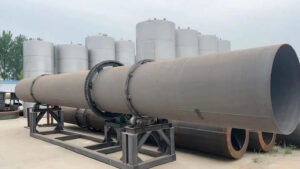
What is a Direct Heat Rotary Dryer?
A Direct Heat Rotary Dryer is an industrial drying system designed to reduce the moisture content of bulk materials through direct contact with a hot gas stream. The wet material is fed into a rotating cylindrical drum, where it is lifted by internal flights and cascaded through the stream of hot air or gas generated by a burner. This intimate contact facilitates highly efficient heat transfer and rapid evaporation of moisture. Widely used in mining, minerals, agriculture, and chemical processing, these dryers are known for their robust construction, high capacity, and effectiveness in handling a wide range of materials.
Heat Source Options for Direct Heat Rotary Dryers & Their Characteristics
The choice of heat source is crucial for efficiency, cost, and product quality.
Natural Gas/Propane Burners: The most common choice. They offer clean combustion, easy temperature control, and relatively low operational costs in areas with gas access. They are suitable for most non-sensitive materials.
Heavy Oil/Light Oil Burners: Used where gas is unavailable. They provide high heat intensity but require fuel storage and handling systems. Combustion can be less clean, potentially contaminating heat-sensitive products.
Coal/Pulverized Coal Burners: A low-cost fuel option for large-scale operations, especially in regions with abundant coal. However, they require complex combustion and ash removal systems and have higher emissions and risk of product contamination.
Biomass Burners: Utilize wood chips, pellets, or agricultural waste. They are a sustainable and often cost-effective choice, promoting energy circularity. The key challenge is ensuring consistent fuel quality and managing higher flue gas volumes.
Steam-Heated Air: Instead of a direct burner, air is heated via a steam heat exchanger. This provides gentler, more uniform heat and avoids product contamination from combustion gases, but it is less energy-efficient overall and depends on a steam boiler.
Electric Heaters: Used for special applications requiring very clean, contamination-free heat or precise temperature control. Their use is limited by very high energy costs.
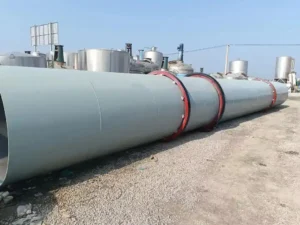
Advantages of Direct Heat Rotary Dryers
Direct Heat Rotary Dryers offer significant benefits:
High Thermal Efficiency & Drying Rates: Direct contact provides excellent heat transfer, leading to faster drying and higher throughput.
Simple & Robust Design: With fewer internal components than indirect dryers, they are less prone to failure and easier to maintain.
Lower Initial Capital Cost: The design simplicity typically makes them more cost-effective to purchase and install than indirect alternatives.
Excellent Material Turnover: The cascading action ensures consistent exposure of particles to the hot gas, promoting uniform drying.
Adaptability: Can handle a wide range of feed consistencies, from granular materials to sludges and filter cakes.
Advantages Over Indirect Heat Rotary Dryers
The primary competitor is the Indirect Heat Rotary Dryer (where material is heated through the drum wall). Key advantages include:
Higher Efficiency for Volatile/High Moisture Removal: Direct contact is far more effective at removing large amounts of moisture or volatile components due to superior mass and heat transfer.
Lower Operating Temperature for Drum Shell: The hot gases are inside the drum, so the shell remains cooler, reducing heat loss and thermal stress.
Ability to Use Combustion Gases: Allows for the use of cheaper fuel sources directly, whereas indirect dryers require a clean thermal fluid or steam.
Better Suitability for Large-Volume, Non-Sensitive Materials: For applications like drying sand, minerals, or ores, direct dryers are the unequivocally more efficient and economical choice.
Less Risk of Material Buildup on Drum Wall: The cascading material is in a hot gas stream, reducing the chance of sticky materials baking onto the drum interior compared to a hot wall.
How Customers Can Choose Based on Their Specific Factors
Selecting the right Direct Heat Rotary Dryer involves analyzing several key factors:
Material Properties: Moisture content, particle size, abrasiveness, heat sensitivity, and flammability dictate drum design, heat source, and gas temperature.
Production Capacity & Moisture Removal Goals: Required throughput (tons/hour) and final moisture specification determine the size (diameter, length) of the dryer.
Available Fuel & Energy Costs: The most economical heat source depends on local fuel availability and pricing (e.g., natural gas vs. biomass waste).
Environmental & Emission Regulations: Regulations may restrict the use of certain fuels (like coal) or require advanced dust collection and gas scrubbing systems.
Plant Space & Layout: The dryer system requires adequate space for the drum, burner, feed system, dust collector, and ducting.
Total Cost of Ownership: Consider not just the purchase price, but also installation, fuel, maintenance, and expected lifespan.
Materials Suitable for Drying with a Direct Heat Rotary Dryer
These dryers are versatile and can process a broad spectrum of materials, including:
Minerals & Ores: Silica sand, limestone, gypsum, clay, iron ore concentrate, bentonite.
Aggregates: Crushed stone, gravel, sand.
Agricultural Products: Animal feed, DDGS (Distillers’ Dried Grains with Solubles), grains, fertilizers (e.g., ammonium sulfate).
Chemicals: Sodium sulfate, PVC resin, various salts, inorganic compounds.
By-Products & Wastes: Biomass, bark, sawdust, filter cakes, sludges (non-hazardous), municipal waste.
Working Principle and Structural Configuration
Working Principle: The process is continuous. Wet material is fed into one end of a slightly inclined, rotating drum. A burner at the same end (or the opposite end, depending on airflow design) introduces hot gases. As the drum rotates, internal flights lift the material and shower it as a curtain through the stream of hot gas, maximizing contact. The dried material discharges at the lower end, while moist exhaust gases exit through a duct to a dust collection system (cyclone, baghouse).
Structural Configuration:
Rotating Drum: The core component, slightly inclined (3-5 degrees), supported by riding rings and trunnion rollers.
Internal Lifters/Fights: Attached to the inner wall to lift and cascade the material.
Gear & Pinion Drive: Provides rotation, usually via an electric motor and reducer.
Burner Assembly: The heat source, located at the feed or discharge end.
Feed & Discharge Housings: Seal the ends of the drum and facilitate material input/output.
Support Structure: Base frame and foundations.
Auxiliary Systems: Includes a feed system (screw conveyor, belt), dust collector, induced draft fan, and control panel.
Custom-Made Direct Heat Rotary Dryers to Meet Client Requirements
We understand that every industrial process is unique. Therefore, we offer fully custom-engineered Direct Heat Rotary Dryers. Customization parameters include:
Size & Capacity: Diameter and length are designed to meet specific throughput and residence time requirements.
Heat Source & Burner Design: Engineered to integrate seamlessly with your chosen fuel.
Material of Construction: Selection of shell thickness, and grades of steel or special alloys to handle abrasion, corrosion, or high temperatures.
Airflow Configuration: Co-current (gas and material flow in the same direction, suitable for heat-sensitive materials) or counter-current (opposite flows, for maximum thermal efficiency and final product dryness).
Special Internals: Custom flight design, breakers, or sections for specific material behavior (e.g., sticky phases).
Integration: Designed to work with your existing feed, product handling, and emission control systems.