
Large Rotary Dryer
The Best Choices for Your Project
- Customization Service:The maximum customizable diameter is 3.5 meters
- Solution:Provide solutions for your problems
- Dryer length: 8 meters to 50 meters.
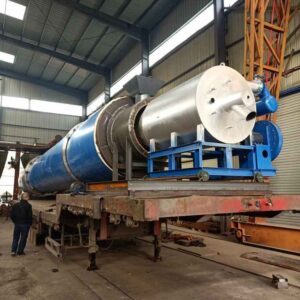
Table of Contents
What is a Large Rotary Dryer?
A Large Rotary Dryer is an industrial-scale drying machine designed to reduce moisture content in bulk materials through continuous rotation and controlled heat. It consists of a large, rotating cylindrical drum, a heating source, and auxiliary systems for handling materials and emissions. Ideal for large-scale production, it efficiently processes high volumes of wet or slurry materials into dry, uniform products.
Main Applications of Large Rotary Dryers
Large Rotary Dryers are widely used in industries requiring massive drying capacity, including:
Mining and Minerals: Drying ores, sand, coal, and minerals.
Agriculture and Biomass: Processing grains, feed, wood chips, and organic waste.
Chemical and Pharmaceutical: Drying chemicals, fertilizers, and synthetic materials.
Construction Materials: Handling clay, limestone, cement, and aggregates.
Environmental and Recycling: Treating sludge, municipal waste, and industrial by-products.
Materials Dried by Large Rotary Dryers
This versatile equipment can handle diverse materials, such as:
Powders and Granules: Silica sand, fertilizers, salts.
Bulk Solids: Coal, iron ore, bauxite.
Organic Materials: Agricultural residues, animal feed, biomass pellets.
High-Moisture Waste: Sewage sludge, industrial sludge, food waste.

Eco-Friendly Systems for Environmental Protection
To address environmental concerns, modern Large Rotary Dryers integrate advanced systems:
Dust Collection Systems: Bag filters or cyclone separators capture airborne particles.
Heat Recovery Units: Reuse waste heat to improve energy efficiency.
Emission Control Scrubbers: Minimize pollutants and odors.
Low-NOx Burners: Reduce harmful combustion emissions.
These systems ensure compliance with environmental regulations while lowering operational costs.
Features and Advantages from a Customer’s Perspective
High Capacity: Processes large volumes continuously, maximizing output.
Robust Construction: Built with durable materials for long-term reliability.
Energy Efficiency: Advanced insulation and heat recovery cut fuel costs.
Uniform Drying: Consistent rotation and airflow ensure even product quality.
Low Maintenance: Simple design with easy-access components reduces downtime.
Automation Compatibility: Supports PLC controls for precise temperature and speed management.
How Does a Large Rotary Dryer Work?
From a customer’s view, the process is straightforward:
Feeding: Wet material enters the rotating drum via a conveyor.
Drying: Hot air (or gases) flows through the drum, evaporating moisture.
Mixing: Internal lifters tumble the material for even exposure to heat.
Discharge: Dried material exits at the drum’s end, while moist air is filtered and released.
This continuous cycle ensures efficient, high-volume drying with minimal manual intervention.
How to Choose the Right Large Rotary Dryer
Consider these factors when selecting a dryer:
Material Properties: Moisture content, particle size, and thermal sensitivity.
Production Goals: Required throughput (tons per hour) and final moisture level.
Heat Source: Availability of natural gas, steam, or biomass fuels.
Space and Layout: Facility dimensions for installation.
Environmental Standards: Local regulations for emissions and noise.
Budget: Balance between upfront investment and long-term operational savings.
Problems Solved for Customers
Eliminates Moisture Issues: Transforms wet, hard-to-handle materials into dry, usable products.
Boosts Productivity: Enables 24/7 continuous drying for large-scale operations.
Reduces Waste: Converts by-products (e.g., sludge) into valuable resources.
Ensures Consistency: Delivers uniform dryness for improved product quality.
Cuts Costs: Lowers energy and labor expenses through automated, efficient drying.
Planning Factors for Large Rotary Dryers
Customizing a dryer depends on:
Material Characteristics: Abrasiveness, corrosiveness, and drying temperature.
Capacity Needs: Hourly output targets and scalability for future growth.
Site Conditions: Available utilities, climate, and space constraints.
Regulatory Compliance: Emission limits and safety requirements.
Operational Preferences: Level of automation and maintenance accessibility.
Custom-Built Large Rotary Dryers: Tailored for Your Needs
We specialize in designing custom Large Rotary Dryers to match unique client demands. For example:
Oversized Dimensions: Drums with large diameters (e.g., over 4 meters) and extended lengths (e.g., 30+ meters) for unprecedented capacity.
High-Throughput Design: Engineered to handle 50–500 tons per hour, ideal for mining or biomass projects.
Material-Specific Features: Custom internals (lifters, baffles) and heat sources for delicate or abrasive materials.
Modular Systems: Integrated feeding, discharge, and pollution control for turnkey solutions.
By collaborating with our engineers, you get a dryer optimized for your material, output goals, and site conditions, ensuring maximum efficiency and ROI.