
Bulk material dryer
The Best Choices for Your Project
- Customization Service:The maximum customizable diameter is 3.5 meters
- Solution:Provide solutions for your problems
- Dryer length: 8 meters to 50 meters.
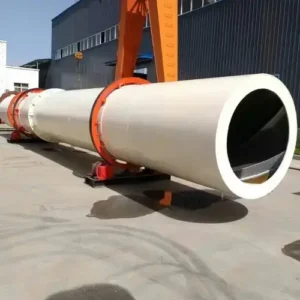
Bulk material dryer
A bulk material dryer is an industrial machine designed to reduce the moisture content of loose, granular, or powdered materials through the application of heat and airflow. These dryers are essential for processing bulk solids, ensuring they meet specific moisture requirements for storage, transport, or further manufacturing. Among the various types of dryers, we primarily use rotary drum dryers for their efficiency, reliability, and adaptability to a wide range of materials.
Bulk material dryers are widely used across multiple industries due to their versatility and efficiency. Key sectors include:
Mining and Minerals: Drying ores, concentrates, sand, gravel, and tailings.
Agriculture: Processing grains, corn, soybeans, and animal feed.
Chemical Industry: Drying chemical powders, fertilizers, pigments, and resins.
Food and Beverage: Dehydrating fruits, vegetables, spices, and tea leaves.
Biomass and Energy: Drying wood chips, sawdust, and other biomass fuels.
Construction Materials: Handling cement, clay, gypsum, and slag.
The following table outlines our standard range of rotary drum dryers. We specialize in customizing these parameters based on your specific material, initial/target moisture content, and production capacity.
| Category | Specification | Model RBD-1210 | Model RBD-1815 | Model RBD-2420 | Model RBD-3025 | Notes |
|---|---|---|---|---|---|---|
| Drum Dimensions | Diameter (m) | 1.2 | 1.8 | 2.4 | 3.0 | Drum size is the primary factor for capacity. |
| Length (m) | 10 | 15 | 20 | 25 | ||
| Slope (%) | 3-5 | 3-5 | 3-5 | 3-5 | Adjustable for material retention time. | |
| Capacity & Performance | Evaporation Capacity (kg H₂O/h) | 1,200 – 1,500 | 2,500 – 3,200 | 5,000 – 6,500 | 8,000 – 10,500 | Highly dependent on material & moisture. |
| Processing Capacity (t/h) | 5-8 | 12-18 | 25-35 | 40-60 | For sand-like materials at ~15% inlet moisture. | |
| Inlet Moisture (Max) | 20-25% | 20-25% | 20-25% | 20-25% | Can be higher for non-sticky materials. | |
| Outlet Moisture | Adjustable (e.g., 0.5-5%) | Adjustable (e.g., 0.5-5%) | Adjustable (e.g., 0.5-5%) | Adjustable (e.g., 0.5-5%) | Precisely controlled by speed & temperature. | |
| Thermal System | Heat Source | Diesel, Natural Gas, Biomass, Steam | Diesel, Natural Gas, Biomass, Steam | Diesel, Natural Gas, Biomass, Steam | Diesel, Natural Gas, Biomass, Steam | Customized burner/heat exchanger design. |
| Fuel Consumption (kg/h) | 70-90 (Diesel) | 140-180 (Diesel) | 280-360 (Diesel) | 450-550 (Diesel) | Varies with fuel type & thermal efficiency. | |
| Inlet Air Temperature (°C) | 600-800 | 600-800 | 600-800 | 600-800 | Max. temperature can be higher. | |
| Outlet Air Temperature (°C) | 100-120 | 100-120 | 100-120 | 100-120 | ||
| Drive & Rotation | Rotation Speed (rpm) | 3-8 | 2-6 | 2-5 | 1.5-4 | Variable Frequency Drive (VFD) for control. |
| Power of Main Motor (kW) | 7.5 | 18.5 | 37 | 75 | ||
| Reduction Gearbox Type | Hardened Gear | Hardened Gear | Hardened Gear | Hardened Gear | ||
| Physical Specifications | Operating Weight (tons) | ~12 | ~25 | ~48 | ~85 | Approximate, varies with configuration. |
| Floor Space (L x W m) | 12 x 4 | 18 x 6 | 25 x 8 | 32 x 10 | Approximate for the main unit. | |
| Efficiency & Features | Thermal Efficiency | >80% | >80% | >80% | >80% | Achieved via internal flights & insulation. |
| Special Features | – Lifting Flight Design – PLC Control System – Insulated Shell – Dust Seal | – Lifting Flight Design – PLC Control System – Insulated Shell – Dust Seal | – Lifting Flight Design – PLC Control System – Insulated Shell – Dust Seal – Heat Recovery Option | – Lifting Flight Design – Advanced PLC/SCADA – Insulated Shell – Dust Seal – Heat Recovery Option | Features enhance efficiency & automation. |
Key Explanations for the Specifications:
Model Naming Convention: RBD-XXYY, where “RBD” stands for Rotary Bulk Dryer, “XX” indicates the drum diameter in decimeters, and “YY” indicates the drum length in meters. (e.g., RBD-1815 = 1.8m Diameter x 15m Length).
Evaporation vs. Processing Capacity:
Evaporation Capacity (kg H₂O/h): This is the most critical performance metric, indicating how much water the dryer can remove per hour. It is more consistent for comparing dryers.
Processing Capacity (t/h): This depends heavily on the initial moisture of the material. A higher water content means a lower throughput of dry product.
Thermal Efficiency >80%: This high efficiency is achieved through:
Optimized Lifting Flights: These constantly lift and shower the material through the hot gas stream, maximizing heat transfer.
Insulated Shell: Reduces radiant heat loss to the environment.
Heat Recovery Systems (Optional): Pre-heats incoming air using waste heat from the exhaust.
Variable Frequency Drive (VFD): Allows for precise control of the drum’s rotation speed. This adjusts the material’s retention time inside the drum, which is crucial for achieving the exact final moisture content for different materials.
PLC Control System: Allows for automated operation and precise control over temperature, speed, and airflow. The Advanced PLC/SCADA system on larger models enables remote monitoring, data logging, and full system integration.
Please note: These are standard models. The final specifications for your project will be engineered based on a detailed analysis of your material and production goals.
Materials Suitable for Drying
Our rotary drum dryers can handle a diverse array of materials, such as:
Ores and Minerals: Iron ore, copper concentrate, bauxite, silica sand.
Agricultural Products: Wheat, rice, barley, oilseeds.
Chemicals: Sodium carbonate, ammonium sulfate, PVC resin.
Bio-Organic Materials: Manure, compost, sludge, distillery grains.
Construction Materials: Limestone, bentonite, fly ash.
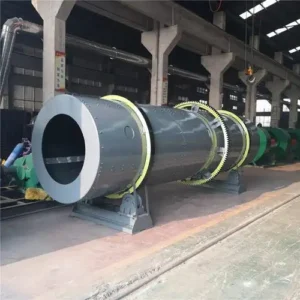
Key Features of Our Bulk Material Dryer
Our rotary drum dryers are engineered with several standout features:
High Thermal Efficiency: Maximizes heat utilization, reducing fuel consumption.
Robust Construction: Built with durable materials to withstand harsh conditions.
Uniform Drying: Ensures consistent moisture reduction throughout the material.
Automated Control Systems: Allow precise regulation of temperature and drying time.
Flexibility: Capable of processing materials of varying sizes and moisture levels.
Measures to Improve Drying Efficiency
To enhance drying efficiency, we have implemented several advanced measures:
Optimized Drum Design: Internal lifting flights tumble the material for better heat exposure.
Heat Recovery Systems: Recycle exhaust heat to preheat incoming air.
Insulated Drum Walls: Minimize heat loss to the environment.
Adjustable Airflow and Temperature: Tailored to specific material properties.
Advanced Burner Technology: Ensures complete and efficient fuel combustion.
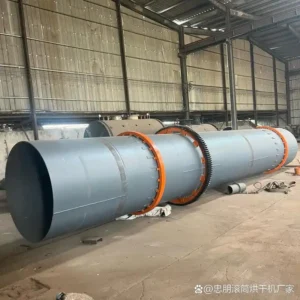
Advantages Over Other Dryers
Compared to other drying technologies, our rotary bulk material dryers offer distinct benefits:
Higher Capacity: Suitable for large-scale, continuous drying operations.
Better Adaptability: Handles a wider range of material sizes and moisture contents.
Lower Operating Costs: Higher efficiency translates to reduced energy use.
Enhanced Durability: Simple design with fewer moving parts lowers maintenance needs.
Superior Drying Quality: Prevents over-drying or under-drying through precise control.
Customized Solutions Based on Client Needs
We understand that each client has unique requirements. Therefore, we provide tailored drying solutions based on:
Production Capacity: Designing systems that match your output needs (from small batches to high-tonnage).
Initial and Target Moisture Content: Engineering the dryer to achieve your desired moisture reduction.
Material Characteristics: Considering particle size, flowability, and heat sensitivity.
Energy Source Availability: Utilizing gas, oil, biomass, or other available fuels.
Space and Layout Constraints: Offering flexible configurations to fit your facility.