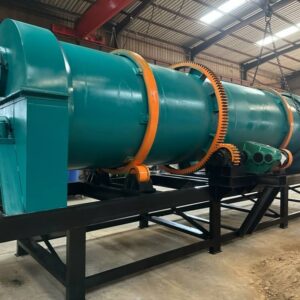
For poultry farms and organic fertilizer producers, managing chicken manure is a major challenge. Wet manure is difficult to handle, store, and transport, and it poses significant environmental and odor issues. This is where a Chicken Manure Dryer becomes an indispensable solution. This guide will explain everything you need to know about this machine, from how it works to how to choose the right one for your operation.
What is a Chicken Manure Dryer?
A Chicken Manure Dryer is an industrial drying machine specifically designed to rapidly reduce the moisture content of fresh chicken manure. By removing excess water, it transforms wet, sticky, and smelly manure into a dry, granular, or powdery material. This process significantly reduces the volume and weight of the manure, making it easier to handle, package, and sell. The final dry product is stable, odor-reduced, and perfect for use as a high-quality organic fertilizer or soil conditioner, unlocking value from waste.
How Does a Chicken Manure Dryer Work? The Principle Explained
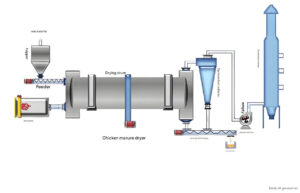
The core working principle involves direct or indirect heat transfer and mechanical agitation. Wet chicken manure is continuously fed into a rotating drum (the most common type). Inside the drum, a series of internal fins or lifters tumble and lift the manure, exposing it to a stream of hot air. As the hot air passes through the cascading manure, moisture evaporates rapidly. The dried manure particles move toward the discharge end, while the moist exhaust air is drawn out through a dust collection and deodorizing system. This ensures efficient, continuous, and environmentally friendly drying.
what Types of Manure Can It Dry?
A robust Chicken Manure Dryer is versatile and can handle various forms of poultry waste:
Fresh Deep-Litter Manure: From barns with bedding materials like straw or sawdust.
Dropping Board/Manure Belt Manure: More concentrated waste collected from caged layer operations.
Slurry or Semi-Solid Manure: A mix of manure and water, often from flushing systems.
A good dryer can effectively process these variations by adjusting parameters like temperature, airflow, and retention time inside the drum.
Integrated Deodorizing System: Eliminating the Odor
A key feature of modern dryers is the integrated deodorizing system. As hot, humid, and odorous air exits the drum, it is first treated in a cyclone separator or dust collector to remove solid particles. The air is then directed through a chemical scrubber (using acid/alkali solutions to neutralize ammonia and sulfur compounds) or a biofilter/bioscrubber (using microorganisms to break down odorous gases). Some systems also employ condensation or thermal oxidizers for high-efficiency odor destruction. This ensures the exhaust meets environmental standards and eliminates nuisance smells for surrounding communities.
The Dust Collection System: What Is It?
The dust collection system is crucial for air pollution control and product recovery. It typically consists of a primary cyclone separator, which removes larger particles and returns them to the process, followed by a secondary baghouse filter or wet scrubber. The baghouse filter uses fabric bags to capture fine dust particles with over 99% efficiency, while a wet scrubber uses water sprays to capture dust. This system keeps the exhaust clean, recovers valuable fertilizer product (the dust), and protects downstream equipment like fans.
Automation & Control Programs
Today’s advanced dryers feature PLC (Programmable Logic Controller) automation. This allows for precise control over:
Feed Rate: Consistent input for stable operation.
Drum Temperature: Optimized for drying efficiency without overheating (which can harm nutrient value).
Hot Air Flow & Speed: Adjustable based on moisture content.
Discharge Moisture: Sensors can automatically adjust parameters to achieve the desired final moisture level.
An automated control panel simplifies operation, improves safety, ensures consistent product quality, and reduces labor costs.
Flexible Heat Source Options
We understand that fuel availability and cost vary by region. Therefore, we offer dryers compatible with multiple heat sources to suit your needs:
Direct Fired: Using coal, biomass (wood chips, rice husk), natural gas, diesel, or biogas.
Indirect Fired: Using thermal oil or steam for heating, where the combustion gases do not contact the manure, suitable for higher purity requirements.
Hybrid or Alternative: Utilizing heat pumps or waste heat from other processes (e.g., biogas power generation).
We help you select the most economical and practical heat source for your specific situation.
How to Correctly Choose a Chicken Manure Dryer: A Buyer's Guide
Choosing the right dryer is critical. Follow these steps:
Assess Your Raw Material: Determine the initial moisture content, daily volume/throughput (e.g., tons per day), and physical form of your manure.
Define Your Goal: What is your target final moisture? How will you use the dried product (packaging, pelletizing, direct application)?
Evaluate Available Space & Utilities: Consider your plant layout, available space for the dryer system, and access to utilities like electricity, water, and your chosen fuel.
Prioritize Environmental Compliance: Ensure the system includes adequate dust collection and deodorizing equipment to meet local regulations.
Consider Total Cost of Ownership: Look beyond the initial price. Factor in energy efficiency, maintenance needs, automation level (which saves labor), and the reputation of the manufacturer for spare parts and service.
Key Points to Consider When Selecting a Dryer
Material of Construction: Contact parts should be made of abrasion-resistant and corrosion-resistant materials (e.g., special steel plates) for long life.
Heat Efficiency Design: Look for features like insulated drums and heat recovery systems to reduce fuel costs.
Manufacturer’s Expertise: Choose a supplier with proven experience in agricultural or organic waste drying, not just generic industrial dryers.
After-Sales Support: Availability of installation guidance, operator training, and prompt technical support is invaluable.
Ask for a Test: If possible, request a small-scale test or trial with your actual manure to verify performance data.
FAQ: More Things You Might Want to Know
Q1: What is the typical moisture reduction, e.g., from what to what?
A: A well-operated dryer can reduce moisture from a wet input of 60-75% down to a storable and manageable 10-20%, depending on the initial condition and the desired final product use.
Q2: Does the drying process kill pathogens and weed seeds?
A: Yes, when the dryer maintains a temperature above 70-80°C (158-176°F) for a sufficient time, it effectively pasteurizes the manure, eliminating most harmful pathogens, parasites, and weed seeds, making the final product safer for agricultural use.
Q3: Can the dried chicken manure be pelletized?
A: Absolutely! The dry, powdered manure is an ideal feedstock for a pellet mill. The consistent low moisture content allows for the production of uniform, high-density organic fertilizer pellets that are easy to bag, transport, and spread.
Q4: How much space does a complete drying plant require?
A: Space needs vary greatly with capacity. A small to medium system (e.g., processing 5-10 tons per day) might require an area of roughly 15m x 30m (50ft x 100ft) to accommodate the dryer, fuel source, conveyor, cyclone, filter, and operational space. Always consult with the supplier for a layout based on your throughput.
Q5: What are the main maintenance tasks?
A: Regular maintenance includes daily checks of bearings and gearboxes (lubrication), inspecting and cleaning the dust filter bags, monitoring wear on the drum internals and fans, and ensuring the burner (if applicable) is clean and efficient. Following the manufacturer’s schedule is key to preventing downtime.