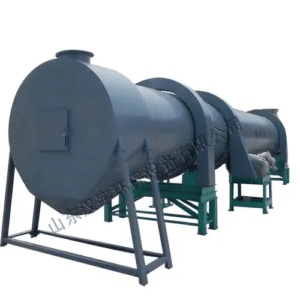
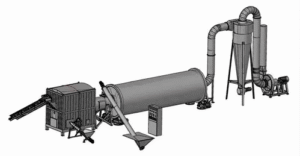
The key components of a rotary dryer include:
Rotating Drum (Shell): The main cylindrical body, typically made of rolled steel plate.
Riding Rings (Tyre Rings): Heavy-duty rings mounted on the drum that support the dryer’s weight on sets of rollers.
Rollers (Support Rollers): Matched sets of rollers that the riding rings rotate on.
Thrust Rollers: Prevent the drum from excessive axial (longitudinal) movement.
Girth Gear & Pinion Gear: The large gear ring attached to the drum and the small drive gear that meshes with it to provide rotation, powered by a motor and reducer.
Internal Lifters/Flighters: Metal plates attached to the inner wall of the drum. They lift and cascade the material through the air stream to maximize exposure.
Feed Hopper & Discharge Chute: For controlled entry of wet material and exit of dried product.
Seals: Installed at both ends of the drum to prevent air and material leakage.
Drive Assembly: Includes motor, gearbox, and sometimes chain/belt drives.
Burner/Furnace & Air Supply: Provides the necessary hot gas (the drying medium).
Dust Collection System: Such as a cyclone or baghouse to capture fine particles from the exhaust gas.
How to Choose the Heat Source for a Rotary Dryer
The selection of a heat source depends on factors like cost, material sensitivity, environmental regulations, and product requirements. Common options include:
Natural Gas/Propane Burners: Most common for direct heating. Clean, efficient, and easy to control. Suitable for materials not sensitive to combustion gases.
Fuel Oil/Coal: Lower cost options but produce more emissions and require handling of ash/residue.
Steam or Thermal Oil (Indirect Heating): Used in indirect rotary dryers where the material cannot contact combustion gases. Heats the shell or internal tubes instead. Ideal for sensitive, toxic, or flammable materials.
Electric Heaters: Used for smaller-scale or specialized applications where clean, precise heat is needed, but operational costs are higher.
Waste Heat from Other Processes: An economical and sustainable choice if a reliable source (like exhaust from a kiln or boiler) is available.
Function of Components During Operation
During operation, each component plays a vital role:
The drive assembly (gears, motor) rotates the drum.
The riding rings and rollers support the massive rotating weight with minimal friction.
Internal lifters pick up the material as the drum turns. At a certain height, the material falls off the lifters, creating a showering “curtain” of particles through the hot gas stream flowing through the drum. This cascading action is the core of the drying process, exposing the maximum surface area of the material to heat.
The seals minimize air ingress/egress, maintaining proper airflow and thermal efficiency.
The burner supplies consistent heat, while the dust collector cleans the exhaust gas, recovering product and meeting environmental standards.
Modifications for Drying Special Materials
Drying special materials often requires specific modifications:
Heat-sensitive Materials (e.g., certain chemicals, foods): Use indirect dryers or lower temperature heat sources. Increase drum length-to-diameter ratio to extend residence time at lower temperatures.
Highly Adhesive or Sticky Materials: Install specialized lifters (like “slingers” or “scoop” lifters) to break up agglomerates. May require internal hammer mills or breakers.
Explosive or Flammable Materials (e.g., fine organic dust): Use inert gas (like nitrogen) as the drying medium in a closed-loop system. Implement explosion-proof design, pressure relief vents, and advanced safety instrumentation.
Corrosive Materials: Line the drum interior or use lifters made of stainless steel or specialized alloys.
Extremely Fine Powders: Optimize airflow and install specialized internal arrangements to prevent excessive dust carry-over. Use low gas velocity and efficient dust collection.
Other FAQs on "How Does a Rotary Dryer Work"
Drying special materials often requires specific modifications:
Heat-sensitive Materials (e.g., certain chemicals, foods): Use indirect dryers or lower temperature heat sources. Increase drum length-to-diameter ratio to extend residence time at lower temperatures.
Highly Adhesive or Sticky Materials: Install specialized lifters (like “slingers” or “scoop” lifters) to break up agglomerates. May require internal hammer mills or breakers.
Explosive or Flammable Materials (e.g., fine organic dust): Use inert gas (like nitrogen) as the drying medium in a closed-loop system. Implement explosion-proof design, pressure relief vents, and advanced safety instrumentation.
Corrosive Materials: Line the drum interior or use lifters made of stainless steel or specialized alloys.
Extremely Fine Powders: Optimize airflow and install specialized internal arrangements to prevent excessive dust carry-over. Use low gas velocity and efficient dust collection.