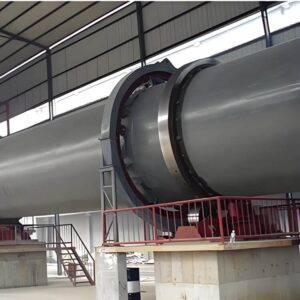
Feeding: Wet materials are continuously and evenly fed into the feeding end of the drying drum by the feeding machine.
Material lifting and dispersion: The drum is equipped with multiple sets of rakes at different angles inside. As the drum rotates at a constant speed, the rakes continuously lift and sprinkle the materials, forming a uniform material curtain, which greatly increases the contact area between the materials and the hot air.
Hot air contact: The clean hot air generated by the hot blast stove (coal-fired, gas-fired, oil-fired or biomass) enters the drum with the material in a co-current or counter-current manner.
Heat transfer and drying: Inside the drum, the material undergoes thorough heat exchange with the hot air, and the moisture is rapidly evaporated.
Discharge: After drying, the material is slowly moved to the discharge end under the inclination of the drum and the guidance of the rakes, and is discharged through the unloader.
Waste gas treatment: Waste gas carrying water vapor and a small amount of dust is purified by environmental protection equipment such as cyclone dust collectors and bag filters, and then discharged up to standard.
Features of rotary Agricultural dryers
Compared with traditional sun-drying or box-type drying, rotary agricultural dryers have incomparable advantages:
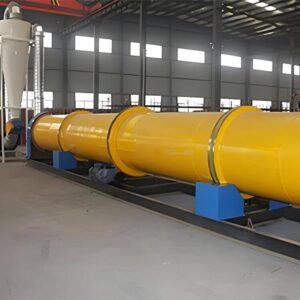
The design of the rotary agricultural dryer adopts high efficiency and energy conservation: continuous operation, large processing capacity, high thermal efficiency, and compared with intermittent drying, it can effectively reduce unit energy consumption.
Uniform drying and excellent finished product quality: The unique raking plate design and drum rotation ensure that all material particles are heated evenly, avoiding problems of uneven or excessive drying, and ensuring stable finished product quality.
Wide application range: By adjusting parameters such as the roller speed, inclination, hot air temperature and wind speed, it can easily handle various materials with different humidity and viscosity.
Simple operation and high degree of automation: The entire system can achieve automatic control, with low labor intensity. It can operate continuously and stably with only a small number of personnel monitoring.
Environmental protection compliance: Equipped with a complete exhaust gas treatment system, it can effectively collect dust and ensure that emissions meet environmental protection requirements.
Stable operation and long service life: The structure is sturdy, and key components are made of wear-resistant materials, which can adapt to harsh working conditions, ensuring a long service life of the equipment
Different materials vary greatly in terms of initial moisture content, viscosity, particle size, heat sensitivity and other aspects. Therefore, we offer professional customization services to tailor the most suitable rotary agricultural dryer for you.
Our customized services include
Material property analysis: Our engineers will have a detailed understanding of your material properties (such as moisture content, viscosity, PH value, specific gravity, etc.), which is the foundation of the design.
Customized production capacity and drying targets: Based on your required hourly processing capacity and moisture content indicators before and after drying, precisely calculate the equipment size and heat load.
Internal structure optimization: In response to the adhesion of materials, we will design a unique “combined raking” system, such as jaw plates and partition plates, to effectively prevent materials from adhering to the wall and caking, ensuring the drying efficiency.
Heat source system matching: Based on your on-site conditions, we recommend the most economical and convenient heat source solution (coal, gas, steam, biomass, etc.) for you.
Environmental protection solution support: We offer a complete set of exhaust gas purification solutions ranging from cyclone dust removal to wet dust removal and bag filter dust removal, ensuring no worries.